Optical Access Network Architectures and Technologies
In the realm of modern telecommunications, optical access networks have emerged as a cornerstone of high-speed connectivity, redefining how data is transmitted and accessed. These networks, designed to bridge the gap between central facilities and end-users, employ advanced technologies and architectures that maximize efficiency and scalability.
Central to their effectiveness is the proximity of the optical network terminal (ONT) to the user, a factor that shapes network performance and capacity. This article explores the primary configurations and topologies that underpin optical access networks. From the widely adopted FTTH (Fiber to the Home) systems to innovative Passive Optical Network (PON) technologies, we delve into the structures and strategies that drive today’s connectivity solutions.
This journey through the technical foundations of optical access networks offers a deeper understanding of their role in delivering reliable, high-speed data services tailored to diverse user environments.
Page Contents
- Optical Access Network Architectures
- Optical Access Network Technologies
- Takeaways
Optical Access Network Architectures
The architecture of optical access networks is determined by the proximity of the optical network terminal to the user. The International Telecommunication Union's Standardization Sector (ITU-T) outlines several primary configurations for this setup.
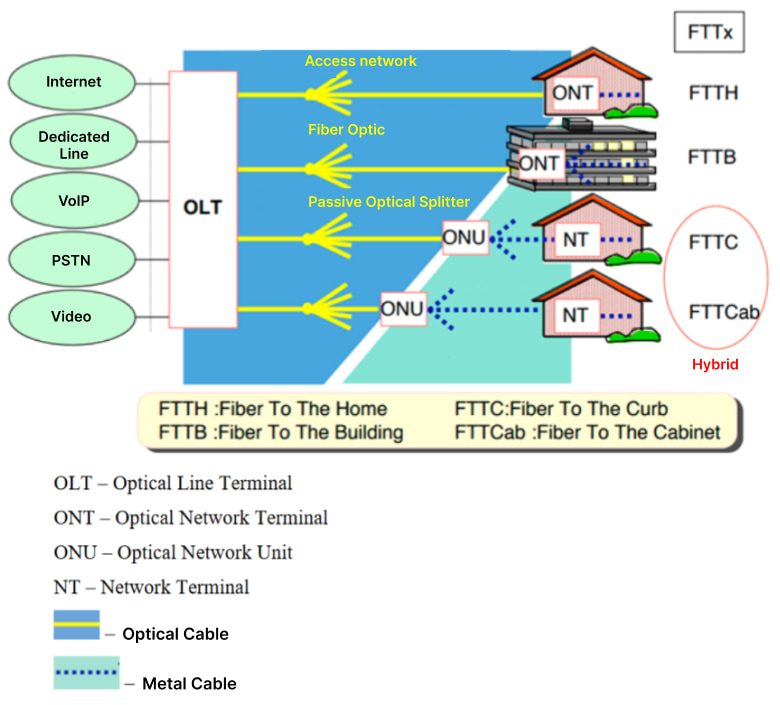
As you can see from the above figure, all FTTx (Fiber to the...) architectures include a segment of copper distribution cables. However, the shorter this segment, the higher the network capacity. The FTTH structure maximizes the use of optical technologies by positioning the optical terminal directly on the user's premises, where it connects via short cables to end devices like a telephone, computer, or TV.
The choice of architecture depends on many factors, primarily population density. However, FTTB can be considered optimal for multi-story buildings. For private homes or offices, depending on the customer’s budget and need for high-speed connectivity, FTTC or FTTH may be the more suitable option.
In modern optical access networks, various network node connection schemes (topologies) can be employed. The choice of an optimal topology depends on several factors specific to the design conditions, such as subscriber density, location, types of services, and the underlying optical technology.
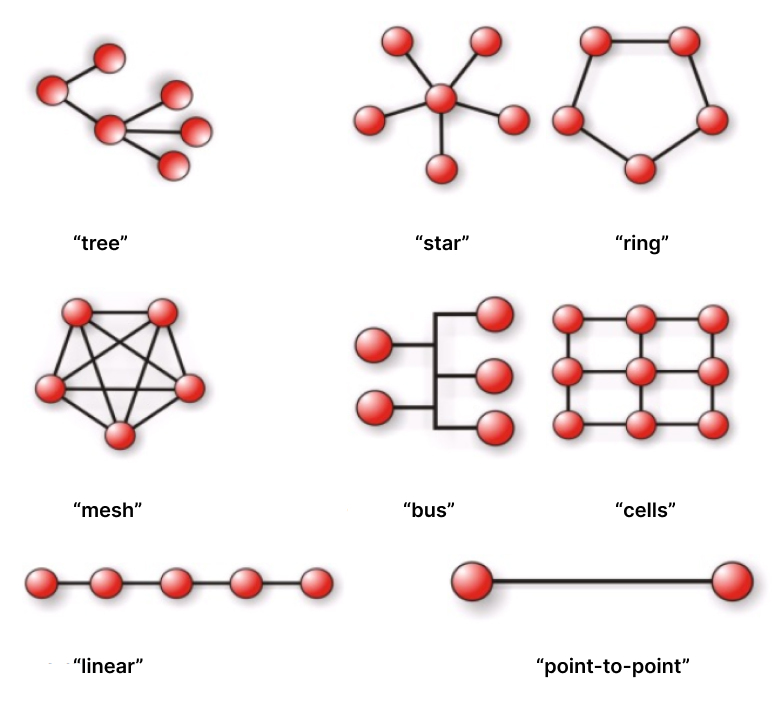
Currently, three integrated technologies are most often used in optical access networks:
- Micro SDH networks;
- Ethernet (Active Ethernet, AE) networks;
- passive optical networks (PON)
Optical Access Network Technologies
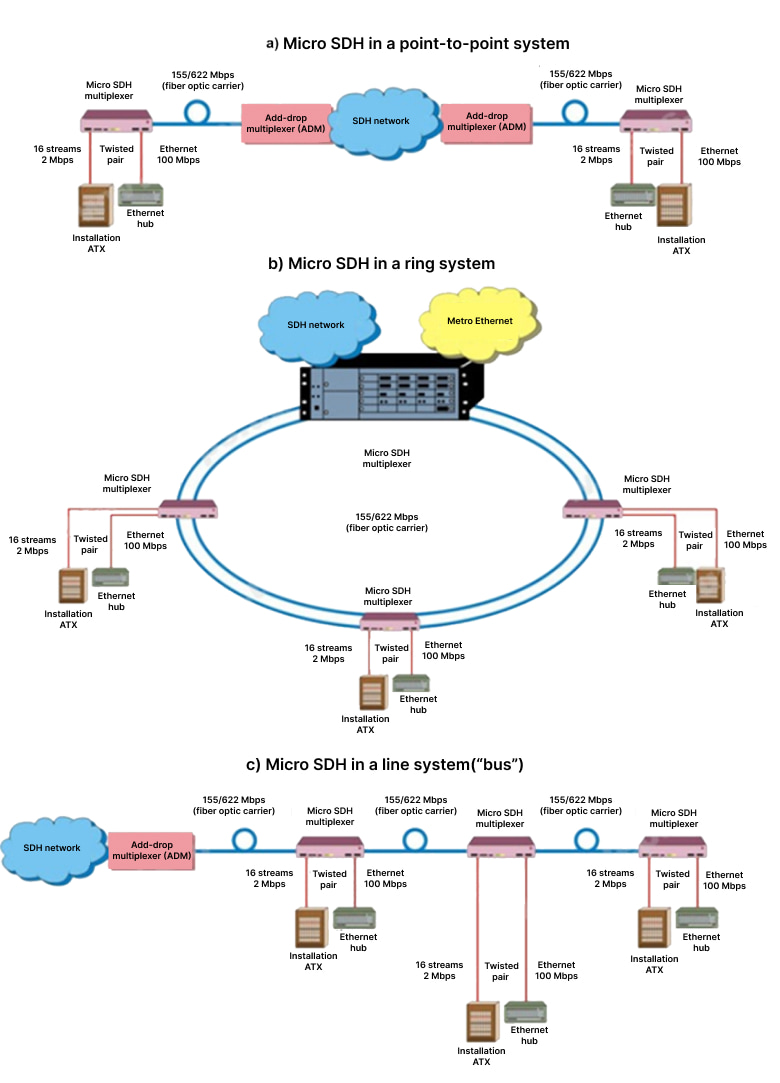
In East and Southeast Asia, as well as in the United States, Micro SDH technology is widely used. STM-1/4 single-board multiplexers with integrated Fast Ethernet and E1 channels are typically employed in ring topologies, though occasionally in point-to-point or bus configurations. These networks are noted for their high fault tolerance, manageability, and ease of maintenance. However, deploying a full ring with a large user base requires substantial investment, with the cost of a single multiplexer ranging from USD 3,000 to 6,000. Moreover, significant challenges may arise when adding new users or creating new network segments. Multiplexer equipment requires stable power, temperature control, and secure protection against unauthorized access. SDH technology, originally optimized for telephone traffic, has proven less efficient for data (Fast Ethernet, Gigabit Ethernet) and video transmission. As a result, this solution is most suitable for the business sector (ring or point-to-point) or for metro area networks (MAN) in a ring topology.
Having gained a strong foothold in local area networks, Ethernet technology has also found extensive use in operator networks across various levels. Relatively affordable, Ethernet technology makes it possible to change access speeds programmatically without replacing equipment. It supports a variety of services (data, voice, video) and transmission types (copper and fiber optic cables), providing a speed hierarchy of 10/100/1000 Mbps. Modern Ethernet capabilities make it easy to add new services, such as IP telephony, Ethernet video, and dedicated channels with guaranteed bandwidth. This technology has gained widespread popularity in Nordic and Central European countries (Sweden, Norway, Germany, Austria, etc.). Established in 2001, the Ethernet in the First Mile Alliance (EFMA) has made a significant contribution to the development and standardization of various Ethernet applications within access networks. Optical networks typically employ point-to-point or point-to-multipoint (star) topologies. This structure is relatively simple to design and maintain, allowing for the adjustment or enhancement of data transmission rates for each individual user. The cost of active equipment can vary widely, ranging from a few hundred to several thousand dollars, depending on the number of ports, features, and level of reliability.
However, active optical Ethernet technology does come with several notable drawbacks. First, the cost of active equipment is relatively high, and installing it requires a reliable power supply. Secondly, while optical cables contain many fibers, and their cost is relatively low, substantial expenses arise from construction, installation, and measurement jobs. Network expansion can be challenging, and laying cables with a large reserve of fibers for potential future subscriber connections is not economically viable.
The practice of building access networks has shown that optical Ethernet is most effective using the FTTB scheme (“fiber to the building”) for new construction, where there is high-quality cable infrastructure, no need to conserve fiber, and the capability to ensure power supply for active equipment.
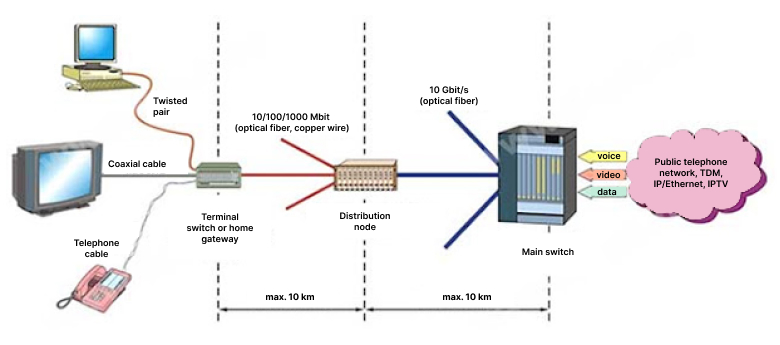
One of the most widely used optical technologies for access networks is the passive optical network (PON). The core concept of this technology is to establish a high-speed access network with minimal capital investment. This involves creating a branched network – typically in a tree topology – without active components, utilizing passive optical splitters. Data for all users is transmitted simultaneously with temporary channel separation from the headend (optical line terminal, OLT) to the optical end devices (optical network unit, ONU). Generally, signals are transmitted and received via a single optical fiber but at different wavelengths. A 1310 nm wavelength is used for the upstream (from the subscriber to the station) and 1490 nm or 1550 nm for the downstream (from the station to the subscriber). The optical power emitted by the OLT is distributed at the network nodes in such a way (either evenly or unevenly) that the signal at the input of all ONUs is roughly the same. One of the wavelengths, typically 1550 nm, is often allocated for transmitting TV signals to all subscribers. To accomplish this, a WDM optical multiplexer is installed at the station, combining signals at 1310 nm (voice, data) and 1550 nm (video). A single optical line can connect up to 32 (in some cases, up to 64) subscribers, with a maximum transmission range of up to 20 km.
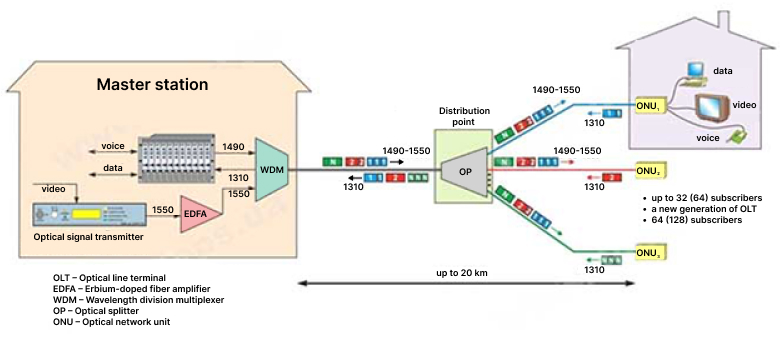
As shown in the diagram, data in the forward direction is transmitted simultaneously to all ONUs, but each end device receives only the information designated specifically for it. In the reverse direction, each ONU transmits data during its assigned time slot, and once combined, the stream includes signals from all users.
The use of PON technology in access networks has many advantages:
- reduction of the number of optical fibers in cables to subscribers;
- significant economy of optical transmitters at the central station;
- the ability to provide triple-play services: voice, video and data;
- no need to power network elements (except for end devices);
- low maintenance costs;
- easy connection of subscribers (without interruption of communication);
- the ability to dynamically expand bandwidth, increasing the transmission speed to active users at the expense of inactive ones;
- the ability to further increase the data transfer rate (up to 10 Gbps and more) without replacing line equipment (optical cables, splitters, connectors);
- the prospect of a significant increase in transmission speed for each subscriber through the use of optical multiplexing (CWDM or DWDM).
Today, PON technology demonstrates the most dynamic development among optical networks. In most developed countries, the number of PON subscribers is growing by 30 – 40% annually. Meanwhile, the only significant factor hindering the rapid implementation of PON is the cost of active subscriber equipment, especially for FTTH.
It is recommended to build PON networks based on the FTTB diagram for multi-story buildings in cities or FTTH for private residential areas, cottage communities and office centers.
PON Varieties
The PON network family includes several implementations, which differ primarily in the main data transmission protocol.
| Name | Standard (Recommended) |
|---|---|
| APON (ATM PON) | ITU-T G.983.x Recommendations |
| BPON (Broadband PON) | ITU-T G.983.x Recommendations |
| EPON (Ethernet PON) | IEEE 802.3ah/IEEE 802.3av Standards |
| GPON (Gigabit PON) | ITU-T G.984.x Recommendations |
In the mid-1990s, APON technology was the first to be developed, utilizing data transmission in the format of ATM cells with service information. This technology supported data transmission speeds of 155 Mbps in both forward and reverse directions in symmetrical mode, and 622 Mbps forward with 155 Mbps reverse in asymmetrical mode. To prevent data conflicts from multiple subscribers, the OLT sent each ONU special messages granting permission for transmission. Today, APON is rarely used.
Further advancements in this technology led to the emergence of the BPON standard. In symmetrical mode, data rates reached 622 Mbps, while in asymmetrical mode, speeds of 1,244 Mbps for downstream and 622 Mbps for upstream were achieved. BPON supports the transmission of three types of information (voice, video, data), with a dedicated 1550 nm wavelength for video. It also enables dynamic bandwidth allocation among subscribers. However, with the arrival of high-speed GPON technology, the economic rationale for using BPON has significantly diminished.
The successful deployment of Ethernet technology in local area networks and the establishment of optical access networks based on it led to the development of a new standard – EPON, in 2000. These networks primarily focus on data transmission at 1 Gbps in both the downstream and upstream directions, using the IP protocol for 16 or 32 subscribers. Given this transmission speed, the term GEPON (Gigabit Ethernet PON) is commonly used in industry literature and corresponds to the IEEE 802.3ah standard. The transmission range for these systems can reach up to 20 km. A 1490 nm wavelength is used for downstream transmission, with 1550 nm reserved for video signals, while the upstream is transmitted at 1310 nm. To prevent conflicts among return streams, the multi-point control protocol (MPCP) is applied. GEPON also supports bridging, allowing for information exchange between users.
The best option for large operators building large-scale branched networks with redundant systems is GPON technology. It represents the next stage of development after APON and BPON, but provides higher transmission speeds: 1244 Mbps in symmetrical mode and 1244 Mbps and 2488 Mbps in asymmetrical mode. The basis of this technology is the SDH protocol (or more specifically, the GFP protocol), with all the advantages and disadvantages it involves. GPON allows connecting up to 32 or 64 subscribers at a distance of up to 20 km (with an option of increasing to 60 km). The technology supports ATM, IP, voice and video traffic (encapsulated in GEM frames – GPON encapsulated method), as well as SDH. The network operates in synchronous mode with a fixed frame length. The use of non-return-to-zero (NRZ) line code with scrambling increases bandwidth efficiency. This said, the only significant drawback of GPON is the high cost of equipment.
Below is a comparative table of the specifications of the three types of PON.
| Parameter | BPON | EPON (GEPON) | GPON |
|---|---|---|---|
| Transmission rate, forward/reverse flow, Mbps | 622/155, 622/622 | 1000/1000 | 1244/1244, 2488/1244, 2488/2488 |
| Basic protocol | ATM | Ethernet | SDH (GFP) |
| Line code | NRZ | 8B10B | NRZ |
| Maximum number of subscribers | 32 | 32 | 32 (64) |
| Maximum network radius, km | 20 | 10 (20) | 20 |
| Wavelength, forward/reverse flow (video), nm | 1490/1310 (1550) | 1490/1310 (1550) | 1490/1310 (1550) |
| Dynamic range, dB: | |||
| - Class A | 5-20 | 5-20 | |
| - Class B | 10-25 | 10-25 | |
| - Class C | 15-30 | 15-30 | |
| RX-10 interface (10 km) | 5-20 | ||
| PX-20 interface (20 km) | 10-24 |
Yet another effective step to increase transmission speeds in PON systems is to use the wavelength division multiplexing (WDM) optical compaction technology (WDM PON). The ITU-T G.983.2 recommendation describes the possibility of transmitting signals at individual wavelengths for each subscriber. A common stream is transmitted in the network, while each subscriber terminal is equipped with an optical filter to separate its specific wavelength. This allows to achieve a transmission speed of about 4-10 Gbps per channel. After this upgrade, providers will be able to adjust the bandwidth to the needs of customers and add or remove ONUs without interfering with the overall system. The introduction of WDM PON in the future will bring significant benefits to operators at minimal cost. While specific types of PON have their advantages and disadvantages, in general, BPON based on the ATM platform no longer provides high transmission speeds and has virtually no prospects. GPON technology is good for networks of large length and capacity. The basic SDH platform provides good protection of information across the network, wide bandwidth, and other advantages. However, more sophisticated and expensive equipment pays off well at high utilization rates.
Unlike GPON, GEPON requires no specific TDM support, synchronization, and protection switching, which makes it the most cost-effective technology of the entire line. This is especially true for small operators focused on IP traffic and later IPTV. In addition, further development of this line is planned – 10GEPON (similar to 10 Gb Ethernet). Thus, due to the best price to quality ratio given an average network size, GEPON remains the most widely used option in many parts of the world.
PON Fiber Optic Cables and Connectors
As per the provisions of ITU-T Recommendation G.983, single-mode optical fibers of the G.652 type or compatible ones (e.g., G.657A) have to be used for PON deployment. Since PON uses fiber optic cables installed in various segments (trunk, distribution, and subscriber) and under diverse conditions (in duct systems, suspended on poles, or within subscriber premises), the cable designs for this network can differ significantly Cable designs are primarily determined by the installation conditions (buried in the ground, placed in cable ducts, suspended on poles, routed through internal building conduits and risers, etc.) and the required number of fibers.
If the number of fibers ranges from 12 to 24, cables with a single-tube core (UT type) are more cost-effective. For higher fiber counts, modular core cables (LT type) are preferable. For underground cable installations, it is crucial to ensure protection against rodents (typically achieved with corrugated steel tape armor) and moisture (via a thick polyethylene sheath, a moisture barrier, and hydrophobic core filling), as well as resistance to tensile forces, accidental mechanical damage, and other environmental factors. Suspended optical cables require high tensile strength (achieved through a supporting cable or other reinforcing elements) and durability against temperature fluctuations (ensured primarily by the materials and design of the outer sheath). For indoor cables, key requirements include flame retardancy (achieved with non-combustible sheaths), flexibility, lightness, and protection against accidental impacts, stretching, twisting, and compression.
The table below shows the factors that affect optical cables installed in different conditions and the design protection methods.
| Installation Environment | Major Impact Factors | Structural Protection Techniques |
|---|---|---|
| Directly in the soil | Rodent damage | Armor |
| Tensile action | Transverse structural elements | |
| Random impacts | Armor | |
| Moisture infiltration | Moisture barrier, hydrophobic filling material | |
| Crushing stress | Core structure, armor | |
| In the cable duct | Moisture infiltration | Moisture barrier, hydrophobic filling material |
| Tensile action | Transverse structural elements | |
| Torsion | Outer sheath | |
| Rodent damage | Armor, protective tubing | |
| Suspension on poles | Tensile action | Transverse structural elements |
| Temperature extremes | Protective sheaths | |
| Moisture infiltration | Moisture barrier, hydrophobic filling material | |
| Random impacts | Armor, sheaths, aramid fibers | |
| UV irradiation | Outer sheath | |
| Cable entry points to the building | Combustion hazard | LSZH or PVC sheath |
| Rodent damage | Armor | |
| Moisture infiltration | Moisture barrier | |
| Tensile action | Transverse structural elements | |
| Indoors | Combustion hazard | LSZH or PVC sheath |
| Small radius bend | Protective sheaths | |
| Tensile action | Aramid fibers | |
| Random impacts | Sheaths, aramid fibers | |
| Crushing stress | Sheaths, aramid fibers |
Special attention should be given to the unique design of the FTTHxxx cable. Its lightweight and compact size, flat construction, peripheral placement of strength elements, low-bend-loss fibers, and distinctive cross-sectional shape make it exceptionally advantageous both technically and economically. These features are ideal for installation in confined spaces without internal ducts or for pole suspension during PON deployment in cottage communities and private residential areas.
When joining cable sections or at branch points of cable lines, cable joints (or couplers) are installed. Their primary function is to house and safeguard optical fiber connections. The design of these joints includes splice trays, which hold welded joints secured in protective heat-shrink sleeves. Within the trays, optical fibers are coiled with an allowable bending radius of no less than 30 mm, ensuring a reserve of fibers is safely stored. The housing of the joint must shield the fibers and splices from moisture, mechanical stress, and climatic influences.
Depending on the positioning of the cable entries, couplers are categorized as feed-through (cable entries on opposite sides) or dead-end (cable entries on one side). The design of the body can be either flat or round. The choice of coupler body type is primarily influenced by the installation conditions. For example, flat couplers are more convenient for attachment to walls in basements, attics, or wells. Dead-end couplers are practical for cable entry from one side, such as installation on poles (e.g., lighting, overhead power lines) using a metal clamp, or for wall mounting using a metal bracket. Feed-through couplers are better suited for underground installation in cable duct wells (mounted on brackets) or for aerial cables suspended on a supporting cable with the use of specialized clamps.
Cable entries must be reliably sealed to withstand external temperature fluctuations, moisture, and other long-term environmental factors. The most common method for sealing is the use of heat-shrinkable tubes. When performed correctly, shrinkage is relatively quick and ensures a secure and tight sealing. Ideally, this process should be carried out with a specialized heat gun, which requires an electrical power supply. As an alternative, an open-flame torch can be used if necessary. Another sealing method involves the application of sealing tape, which is wrapped around the outer sheath of the cable at the entry point into the coupler. After tightening the union nut on the inlet sleeve, the soft tape fills all the gaps at the entry point, effectively sealing it. This method doesn’t involve hot-mounting techniques, but it demands precision and meticulous execution during installation. However, couplings with such seals are not recommended for areas exposed to constant moisture.
When selecting a coupling type, it is essential to consider the number of cable entry ports and their diameters. Some designs permit the insertion of two small-diameter fiber optic cables into a single large port, with separation achieved during the shrinkage process using a metal clip with a hot-melt adhesive insert.
When cables with metal components are introduced into the coupling, these elements must be interconnected and, if necessary, grounded. To facilitate this, the coupling contains a grounding bar equipped with screw fastenings for securing the metal structural elements.
PON Cross-Connect and Distribution Equipment
Fiber optic cables installed in buildings are routed through internal risers and ducts and terminate at a terminal cable device (box). Within these boxes, optical line fibers are connected to patch cords or cables that link to subscriber terminals (ONUs). Optical boxes may also facilitate the branching of cable lines.
Optical boxes are constructed with a closed housing featuring cable glands, inside which splice trays are installed. The housing is equipped with openings sealed with grommets for routing connecting cords (pigtails, patch cords) or single-fiber cables. Additionally, the boxes may include a panel for mounting connector adapters.
The way the boxes are placed depends on the actual conditions in the customer's premises. The device may be located in technical niches, cabinets, or simply attached to walls, beams, supports, columns in any available rooms.
When selecting the appropriate box design, the primary considerations should be the number of single-fiber cables (or cords) to be terminated and the type of their connection to the main optical cable. For welded connections, splices are housed directly in the splice tray, whereas for detachable connections, the box must include a front panel with the required number of adapters. The dimensions and material of the box are determined by the specific installation location and method.
| Box type | Case material | Tray type | Tray number | Number of welded joints | Number of sleeves per set | Number of cord outlets (adapters) | Dimensions, mm | ||
|---|---|---|---|---|---|---|---|---|---|
| Per set | Max. | Per cassette | Max. | ||||||
| FOB-AM | Plastic | - | - | - | - | 6 | 6 | 4 adapters | 152×105×32 |
| FOB-BM | Metal | S037 | 1 | 2 | 6/12 * | 12/24 * | 6 | 12 | 210×110×50 |
| FOB-DM | Metal | S037 | 1 | 2 | 6/12 * | 12/24 * | 12 | 12 | 198×112×45 |
| FOB-B | Metal | S024 | 1 | 2 | 6/12 * | 12/24 * | 12 | 24 | 303×143×50 |
| FOB-D | Plastic | S009 | 1 | 2 | 6/12 * | 12/24 * | 12 | 24 | 270×155×53 |
| FOB-C | Metal | S024 | 1 | 2 | 6/12 * | 12/24 * | 12 | 8 adapters | 353×170×50 |
| FOB-SH | Plastic | S016 | 1 | 3 | 8/16 * | 24/48 * | 12 | 48 | 320×145×50 |
| FOB-G | Metal | S016 | 2 | 4 | 8/16 * | 32/64 * | 32 | 32 adapters | 305×355×90 |
On the stationary side, fiber optic cables are connected to optical distribution devices, typically mounted in 19-inch racks. These station-side optical boxes, also known as optical distribution frames (ODF), are usually designed with a housing that includes cable entries, a set of splice trays, organizers for arranging cable modular tubes and cords, and screw mounts for securing metal strength elements. Front panels with adapters for the required type of connectors are installed on the front of the housing. An example of an ODF is shown in the figure below.
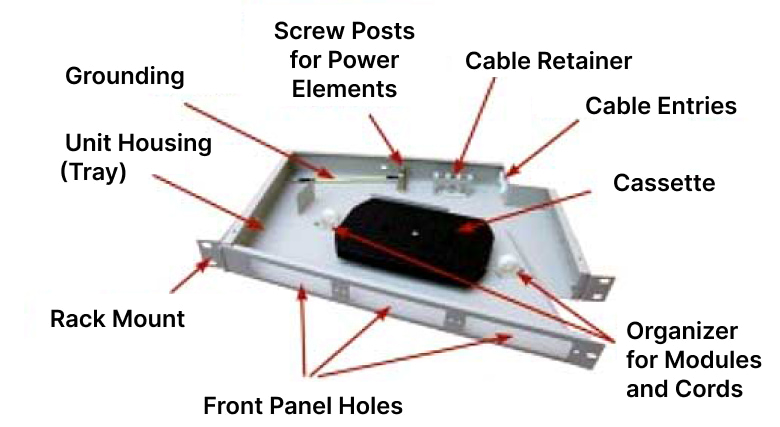
19-inch optical boxes vary by the number of splice trays and, consequently, their height (1U, 2U, or 3U). They support a maximum of up to 72 fiber connections. The cable entries feature a cone-clamping port design, ensuring a secure fit regardless of the cable diameter. A grounding conductor with a terminal is attached to the screw mounts for connection to the rack's main body. The front part of the boxes includes pre-cut openings for mounting front panels with adapters for various connector types (FC, SC, LC, etc.). The convenient swivel-and-slide design allows easy access to the trays and fibers after the box is installed in the rack. The box comes fully equipped with sleeves, ties, screws, grounding wire, and other components, meeting all necessary operational requirements.
PON Optical Connecting Cords
Optical cords are a critical component of PON networks, as they are widely used, particularly in areas where frequent switching operations occur. Consequently, the transmission parameters and reliability of these cords play a significant role in ensuring the overall quality and performance of the network.
To connect two optical equipment ports, connecting cords with passive terminations on both ends and a 3 mm diameter are used. The fiber is covered with a layer of aramid fibers and a durable outer sheath made of polyvinyl chloride (PVC) or non-combustible low-smoke zero-halogen (LSZH) plastic.
Pigtails, cords with one connector and a single exposed fiber, are used to connect optical cables to terminal or distribution equipment. These cords feature tightly buffered fibers with a 0.9 mm diameter and no outer sheath.
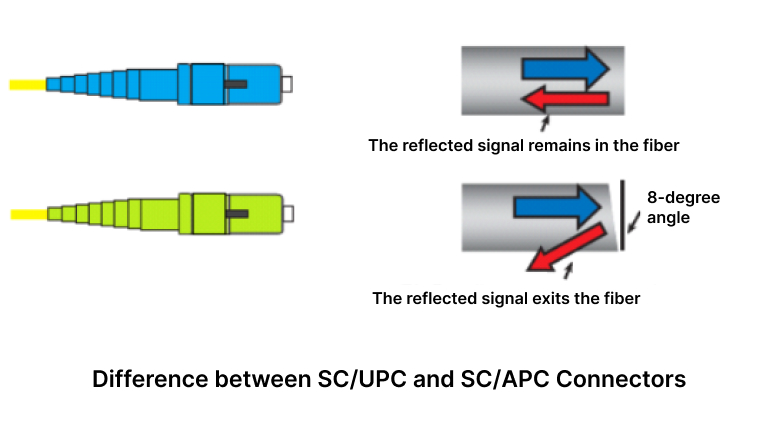
Patch cords come in a wide variety of designs and with different types of connectors (FC, SC, LC, etc.), though SC connectors are most commonly used in PON networks. Connector end-faces are polished in two ways: standard spherical physical contact (PC or UPC) or angled physical contact (APC). APC connectors significantly reduce reflection losses by directing reflected power away from the core/shell interface at angles greater than the critical angle. This feature is particularly important in networks where optical transmitters are sensitive to high levels of reflected power. In PON networks with cable TV integration, only APC-polished connectors with green housings should be used at all connection points. Outer jackets are made from non-combustible materials, such as PVC or LSZH.
Typically, fiber optic measurement equipment features PC-polished connectors on its optical ports. Thus, when testing passive optical networks, it is necessary to use hybrid passive components, where one connector is PC-polished and the other is APC-polished.
At high port density and limited space for installing cords in cross-connect or distribution equipment, passive cords or pigtails may be bent with a radius smaller than the allowable 30 mm. At such critical bending points, additional losses of several dB may occur. For use in such conditions, it is recommended to employ cords with fibers that have reduced bending losses (G.657 type). In these cords, even with bending radii of 15-20 mm, the induced losses will remain minimal (a few tenths of a dB).
PON Optical Splitters
When constructing passive optical networks, an optical splitter is an essential element. It is these elements that provide the network with the necessary architectural flexibility, scalability, maximum compliance with system specifications, and cost-effectiveness. As a matter of fact, optical distribution has been successfully used for quite some time in cable TV networks where it is necessary to create branched tree architecture with uniform or uneven distribution of optical power. However, it was during the implementation of PON that splitters proved to be a key element of the network.
The PON topology is standardly tree-like. Splitters are selected based on the location of the customers (which are best located and marked on the map), with many options available. Splitters can be X-shaped or Y-shaped, welded (fused), or planar. They differ in manufacturing technology, attenuation levels at each output after signal distribution, and the number of inputs. In PON networks, X-shaped splitters are typically used to “add” TV signals to the downstream flow, while Y-shaped splitters are used for standard tree topology construction.
Welded splitters made using fused biconical taper (FBT) technology are formed as follows: two fibers with their outer sheaths removed are fused into an element with two inputs and two outputs (2/2), after which one input is cut off and covered with a non-reflective material to form a 1/2 splitter. In this case, the signal power at each output of the splitter is equal to a certain percentage of the signal power at the input to the splitter (usually 50% to 50%). It is possible to provide power distribution in different proportions, for example, 30% to 70% (30% of the signal power goes to one arm, and 70% to the other). Welded splitters typically have one to three transparency windows (1310 nm, 1490 nm, or 1550 nm).
Planar Lightwave Circuit (PLC) splitters are produced through a multi-stage process. The first stage involves applying a reflective cladding layer to a substrate. Next, a waveguide material (glass) is deposited onto this layer, and a mask for etching is created. The etching process results in a waveguide system that functions as an optical splitter. This planar waveguide system is then covered with a second reflective cladding layer. Pigtails are attached to the completed planar waveguides through welding, and the assembled device is enclosed in either a plastic or metal housing.
The desired number of branches in a PLC splitter is achieved by combining 1×2 dividers. Planar technology enables the production of compact and reliable splitters with up to 64 output fibers. These splitters feature more stable and precise output characteristics, operate within a broadband wavelength range of 1260 to 1650 nm, and exhibit lower attenuation per port compared to welded splitters with branching ratios greater than two.
In summary, planar splitters typically provide equal attenuation across all outputs and evenly divide the input signal into 2N outputs (e.g., 1×2, 1×4, and up to 1×64). In contrast, welded splitters are generally 1×2 and exhibit uneven attenuation at the outputs. Welded splitters with more than two outputs are created by combining multiple 1×2 splitters with output power ratios ranging from 1/99 to 50/50.
Designing a PON
After selecting the active equipment, designing a PON typically involves the following steps: identifying the locations of optical network units (ONUs), choosing the network topology, planning cable routes and splitter placement, calculating the loss budget for each branch, and optimizing splitter ratios.
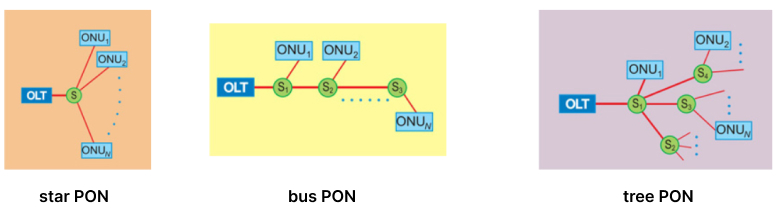
The placement of user terminals is easily determined by the actual locations of the users, while the choice of topology can involve several options. In addition to the popular tree topology, star and bus topologies are also used. The star topology is suitable for densely clustered subscribers located near the headend. In this arrangement, the splitter is installed directly at the station next to the optical line terminal (OLT), simplifying maintenance and fault detection. However, this setup does not save fiber as effectively as the point-to-point topology and may be inefficient for dispersed subscriber locations.
The bus topology is perfect for subscribers positioned along an optical backbone. While economical, it requires a significant power differential between splitters (e.g., 1/99 or 3/97), which is challenging to implement with precision. This topology is effective only with a linear arrangement of users and a limited number of cascades. Otherwise, the signal losses become too great for stable transmission.
The tree topology remains the most popular choice due to its flexibility for network expansion and accommodating a growing number of subscribers. Selecting the appropriate splitter division ratios enables optimal power distribution among branches. Although measurements, particularly from the station side, may be challenging, this topology is recommended for servicing local subscriber clusters.
The selection of cable installation routes depends on local conditions, including the availability of cable ducts, permits for their use, the presence of poles (e.g., lighting, contact networks) along the cable paths, and other factors.
It is recommended to install optical splitters in locations that are easily accessible for installation and maintenance, such as couplings, distribution cabinets, boxes, or optical distribution frames. Bare fiber splitters are the simplest to install, as they can be placed in the designated slots within splice trays. Welded joints in such splitters result in significantly lower losses compared to connectorized connections, thereby enhancing reliability. Enclosed splitters are convenient for performing in-service measurements. To conserve fiber, it is advisable to place them as close to subscribers as possible. However, the final placement depends on the specific project conditions. The key task in network design is calculating the loss budget and determining the optimal splitter distribution ratios. The main steps in the calculation process are as follows:
- calculation of total losses for each branch, excluding splitter losses;
- step-by-step selection of distribution ratios for each segment, starting with the remotest ones;
- calculation of the loss budget for each user terminal, comparing it with the dynamic range of the system.
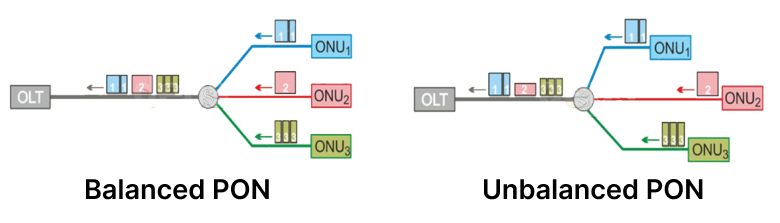
Since subscribers are typically located at varying distances from the headend, uniform power distribution in splitters can lead to unequal power levels at the input of each ONU. Therefore, it is crucial to configure the splitters' parameters so that the optical power levels at the input of each subscriber terminal are nearly equal, resulting in a balanced network. This is important for two reasons: first, a balanced network ensures consistent attenuation margins in each branch, allowing for future expansion; second, minimizing significant differences (greater than 10-15 dB) in signal levels at the OLT terminal input reduces errors in the return path caused by detection issues.
Measurements in PON
The issue of measuring passive optical networks’ (PON) parameters during construction, installation, and operation is extremely important and has a number of features compared to other types of optical networks.
After completing construction, it is essential to accurately measure the actual network parameters during acceptance testing. This allows verification of compliance with the design specifications (e.g., loss budget), evaluation of potential network expansion in specific areas, and smoother future operation of the PON.
In the event of localized damage in a PON, the challenge is to promptly detect the fault while maintaining the functionality of other segments of the tree network, as disconnecting all users is economically impractical. Proper identification of measurement points, selection of testing schemes, and accurate interpretation of results are crucial.
In the event of localized damage to the PON, the challenge is to quickly detect the fault while keeping other segments of the tree network functional, as it is economically unprofitable to disconnect all users. It is important to correctly identify areas for measurement, select test scenarios, and accurately interpret the results.
Measuring equipment for fiber optic networks is relatively expensive, and for PONs, it is preferable to use specialized devices that account for the transmission of three wavelengths, high-power TV signals, the pulsed operation of ONU transmitters, and other specific features. Therefore, selecting the appropriate type and specifications of measuring equipment tailored to the network is crucial.
At various stages of PON creation and operation, the following types of measurements may be performed: incoming inspection, construction and installation measurements, acceptance testing, and operational measurements.
Incoming inspection of network components is carried out prior to construction to verify that the specifications of cables, cords, splitters, and other elements meet the specified parameters. However, for small subscriber networks, full testing procedures may be impractical due to the considerable time spent and high cost of equipment involved. In such cases, selective control testing, for example, measuring the attenuation coefficient of several cable sections in reliance on the supplier’s guarantees, seems a preferred option.
During network installation, measurements are taken to assess the quality of works, such as suspending an overhead cable or connecting optical fibers.
Acceptance testing is performed after the construction is completed to confirm that the network meets the specified parameters and to ensure the required quality of data transmission. Operational measurements are carried out in case of signal deterioration, network damage, or after repairs.
PON Construction and Installation Measurements
During construction and installation works, measurements are often necessary to ensure the quality of components and the proper installation of the PON. These measurements include the linear attenuation of optical cables, losses at fusion splices, and both attenuation and reflection losses in passive components such as connectors and splitters.
The most suitable tool for this purpose is an optical time-domain reflectometer (OTDR), which connects to one end of the line and allows for visualizing the distribution of reflected power along its entire length. Measurement results are displayed as a graph (reflectogram) that illustrates the optical signal power distribution along the line. The slope of the graph on uniform sections can be used to determine the cable attenuation coefficient (in dB/km), while local irregularities (such as fusion splices, connectors, and fiber bends) reveal losses and reflections.
After completing construction works on individual network segments, it is advisable to perform OTDR measurements (preferably at two wavelengths) and save the reflectograms for future reference. During operation, these reference reflectograms can be compared with “emergency” ones to quickly identify damage or irregularities. This significantly accelerates fault detection and localization.
It is also recommended to take new reflectograms when changing the network topology (connecting a new subscriber, replacing splitters, etc.).
During acceptance testing, measurements are typically conducted to evaluate transmission speed, error-free performance, and other metrics that characterize signal quality. The key factors influencing quality in the linear path between the transmitter and receiver include attenuation, dispersion (both chromatic and polarization), and non-linear effects.
Signal attenuation in optical cables, cords, connectors, splitters, and other PON components reduces the signal level at the photodetector input, worsening the signal-to-noise ratio and increasing the error rate. Aggregate attenuation depends on the line length, the number and losses of passive components, and the number of connections. The aggregate attenuation in the linear path must be verified against the calculated loss budget. Additionally, the losses introduced by individual network elements (e.g., connectors, splitters) can be measured as well.
Dispersion of optical signals occurs due to varying propagation speeds of spectral (chromatic dispersion) or polarization (polarization-mode dispersion) components. This results in pulse broadening or phase distortion of analog signals within the fibers, leading to errors in signal recognition by the photodetector. Consequently, it degrades the signal-to-noise ratio and increases either the error rate or distortion coefficient of TV signals (SCO). Chromatic dispersion has a significant impact on signals transmitted over long distances (tens or hundreds of kilometers) at high data rates (over 1 Gbps), particularly at a wavelength of 1550 nm. While this parameter is considered during network design, dispersion measurements are typically not conducted during construction or operation.
Non-linear effects occur in optical fibers when high optical power is used to transmit TV signals at a wavelength of 1550 nm. When the power exceeds a certain threshold, new frequency components arise due to non-linear (Mandelstam-Brillouin, Raman) scattering, resulting in partial signal loss and the generation of parasitic signals that can degrade transmitter performance. However, modern TV signal transmitters are equipped with systems that effectively suppress these effects at power levels of up to 18 dBm.
PON Acceptance Measurements
For PON acceptance tests, only measurements related to power distribution in the network are fundamentally important. Thus, it is crucial to carry out two types of measurements:
- measurement of optical power at the output of transmitting devices;
- measurement of attenuation in the optical linear path.
For simplicity, the optical power of transmitters in the cross-connect after the WDM multiplexer can be measured at wavelengths of 1490 nm (OLT emitter) and 1550 nm (TV signal transmitter). If the measured values deviate from the design specifications, additional measurements should be conducted directly at the output of both transmitters and at the output of the optical amplifier. It is also recommended to measure the power at the input of the optical receivers of the line and network terminals.
The power at the WDM output must be measured with a device that has built-in filters to measure each wavelength separately, because a conventional power meter will show a total value that doesn’t characterize different transmitters.
It is essential to measure the total attenuation in the linear path for all branches of the passive optical network. If the measured loss exceeds the calculated value, the signal loss at specific key points of the network should be assessed. Attenuation measurement of the optical network or its segment is typically performed using the insertion loss method with a calibrated light source and an optical power meter, or with an optical tester that integrates both devices into a single unit.
In the absence of a calibrated radiation source as a standalone device, an OLT transmitter (at 1490 nm) or an optical TV signal transmitter (at 1550 nm) can be used as a last resort to measure attenuation at various points in the linear path. Assuming their radiation is nearly continuous, the power should first be measured at the transmitter output and then at the specified point along the line. The difference in power levels (in dB) will indicate the attenuation of the measured network segment.
PON Operational Measurements
Operational measurements in optical networks are usually divided into scheduled and emergency measurements. Scheduled measurements are performed on a regular basis to monitor the core parameters of the network and predict any potential data transmission issues.
However, in day-to-day PON operation, the need for measurements usually arises only in the event of emergency or pre-emergency situations. The main purpose of such measurements is to quickly identify the cause of signal quality degradation or damage in the network.
Knowing the nature of a malfunction, it’s possible to attempt to predict its cause, but this isn’t always feasible. For instance, a drop in signal strength at the receiver could be caused by the degradation of the transmitter’s laser or issues in the line path, such as a cable or patch cord bent at a small radius, excessive fiber tension in an aerial cable, and other factors.
The first step is to use the diagnostic capabilities of the OLT and the cable television optical transmitter. Both devices allow you to monitor the laser output power, pumping current, temperature, and other parameters. The OLT management system can also identify each ONU subscriber terminal and monitor its performance. By determining the number and location of failed ONUs, it’s possible to quickly identify the damaged network segment. However, it should be remembered that a terminal disconnected from the power supply will be treated by the OLT system as faulty in the same way as those ONUs that aren’t functional due to a network break.
To troubleshoot a line without an OTDR, the power level at different points in the network can be measured using a power meter with a radiation source or an OLT transmitter. However, this method is unsuitable for networks with unshielded splitters, which are commonly used, as they introduce additional losses. Therefore, an OTDR remains the most accurate tool for fault localization.
Measurements with an OTDR
The fundamental principle of an OTDR's operation is that the device emits light pulses, which are reflected by irregularities in the fiber (Rayleigh scattering) or localized defects in the fiber optic line (such as welded or connector joints, fiber deformations, etc.). Part of the reflected pulse (reflected signal) travels back through the splitter and is captured by the OTDR's sensitive detector.
Analyzing the time between the emission of the pulse and the receipt of the reflected signal helps determine the distance from the point of pulse input to the point where the irregularity occurred. Since Rayleigh scattering occurs in every section of the fiber, measuring its level makes it possible to estimate the attenuation of the signal during its propagation. Fresnel reflection occurs at the interface, for example, at a fiber break or at connectors, and it appears on the trace as a much more powerful reflected signal compared to Rayleigh scattering.
Most fiber optic professionals are familiar with the principles of OTDR and reflectogram analysis. A more detailed coverage of these issues would require more volume, so we will limit ourselves to considering the general features of the OTDR, their specifications, and methods of operation in passive optical networks.
Parameters of OTDR for PON Measurements
When choosing an OTDR for PON testing, it’s important to understand which features are critical to the job and which ones only add convenience but are inessential. After all, these devices are expensive, and buying an OTDR with unused features can involve unnecessary costs, while the lack of important parameters may affect the efficiency of measurements. If you purchase an overly expensive device, you will rarely use its full potential, and in other situations, you will have to rent additional equipment or spend more time and effort searching for faults.
Let's consider the key parameters of OTDR for use in passive optical networks:
- Dynamic range (in dB) is an important indicator that demonstrates the OTDR's ability to measure a signal. For PON, a range of 32-38 dB is recommended for lines up to 10-20 km long. A smaller range is possible, but the network loss budget should be factored in.
- Dead zone (in meters) reflects the distance between adjacent reflections in an optical fiber. A good indicator is 2 – 3 m for the reflection dead zone, and 8 – 10 m for the attenuation dead zone.
- Operating wavelength (in nm) – OTDRs for PON typically operate at 1310 nm and 1550 nm. An additional emitter at 1625 nm allows measurements without interruption of communication.
- Pulse duration (in microseconds) affects the accuracy of fault location. For PON, a minimum pulse duration of no more than 10 ns is recommended.
- Distance range (in km) is the distance at which the OTDR collects data on the reflected signal. For PON, it is desirable to have a minimum viewing range of 2 to 6 km.
- Real-time mode enables instant display of changes on the line and is highly useful for monitoring connections.
- Auto mode simplifies measurements for inexperienced users by enabling the device to independently select measurement parameters.
- Identification of the active device at the remote end is important for working with existing PON networks.
- Report generation function is designed for creating documentation about the measured line.
- Integrated red light source stands for a laser for visual detection of breaks in fibers.
- Simultaneous viewing of multiple reflectograms facilitates fault detection by comparing different measurements.
- Optical tester mode with LF modulation allows OTDR to work as a light source and power meter.
These and other characteristics of OTDR should be considered when choosing, seeking the advice of specialists for the optimal solution.
Takeaways
Optical access networks represent the backbone of modern high-speed connectivity, combining cutting-edge technologies and strategic architectures to meet the growing demands of data transmission. As explored in this discussion, their effectiveness is determined by a variety of factors, including the proximity of the optical network terminal (ONT) to the user, the choice of topologies like tree, star, and point-to-point, and the deployment of advanced technologies such as PON, Ethernet, and Micro SDH.
The flexibility and scalability of these networks are evident in their ability to support diverse applications, from urban FTTH deployments to expansive FTTB configurations for multi-story buildings. Passive Optical Networks (PON) have emerged as a key player, delivering high-speed data, voice, and video services with minimal infrastructure costs. The seamless integration of WDM technology and the efficient allocation of bandwidth highlight the potential for future enhancements, such as increased data transmission rates and improved subscriber density.
The construction and operation of these networks demand meticulous attention to component quality, installation conditions, and precise measurement techniques. Optical splitters, couplers, and fiber optic cables are engineered for specific environments to ensure durability, scalability, and optimal performance. Measuring tools, such as OTDRs, play a pivotal role in ensuring network reliability and facilitating quick fault resolution.
From design considerations like loss budgeting and splitter placement to the integration of state-of-the-art multiplexing technologies, optical access networks exemplify a sophisticated synergy of engineering and innovation. The careful alignment of components, topologies, and technologies ensures a balanced network capable of meeting the diverse needs of end-users.
As the demand for high-speed, reliable connectivity continues to grow, these networks are poised to remain at the forefront of technological advancement. Whether through the cost-effectiveness of GEPON, the robustness of GPON, or the versatility of Ethernet-based solutions, optical access networks provide a scalable foundation for the digital future, enabling seamless access to the data-driven world.